Zambian 2013 Budget Reviewed by Kampamba Shula

On 12 October 2012, the Minister of Finance, Hon. Alexander Bwalya Chikwanda, MP, announced the 2013 National Budget. Budget highlights and taxation and other changes as contained in the Budget speech and the Zambia Revenue Authority (“ZRA”) publication.

INDECO (IDC): Past Problems and Opportunities Analysed by Kampamba Shula

INDECO (IDC): Past Problems and Opportunities Analysed

Critical Review of IMF 2013 Zambia ARTICLE IV CONSULTATION report by Kampamba Shula

Debt management is still on track The agreed norm is that for internal borrowing the threshold is 25 per cent of GDP but our debt stands at K17 billion, which is 15 per cent of GDP and for external borrowing, the threshold is 40 per cent and our debt is US$3.1 billion which is 14 per cent of GDP, so we are far below the agreed norms. So even in the long term , Zambia is still on track.

US Economy 2014 First Quarter Analysis and Outlook by Kampamba Shula

New data shows the U.S. economy contracted in the first quarter of this year, keeping pace with shifting expectations but down sharply from the prior already disappointing estimate.

Zambia Debt Analysis

Some might say that Zambia should not borrow externally and even as sincere as they may be they are wrong. When the Government borrows locally “Crowing out” happens.

Monday, March 23, 2015

The Inevitable Depreciation of the Zambian Kwacha - Causes, Consequences and Policy


Zambia is mostly a commodity exporting based economy with a lot of business people importing most of their tradables for sale. Hence when the kwacha depreciates the incentive for local business people to raise their prices is high. There is a general view among the public that a “strong” kwacha represents a strong economy. This view while having its merits is flawed for several reasons. Firstly most of Zambia’s exports are copper; hence a strong Kwacha usually means that copper prices are sufficiently high to sustain favorable exchange earnings. Secondly this view undermines the Government’s effort to diversify the economy away from copper. 
In Zambia outside the minerals sector, exported output is low, imported inputs high, and foreign currency debt low. These combine to create a strong probability that a depreciation of the currency would generate net disincentives to agricultural and manufacturing producers in Zambia. It is for this reason that many in the government and the private sector argue in favor of a "strong" (appreciating) currency, as a necessary support for diversification into agriculture and manufacturing. 
Currency appreciation is a blunt instrument to stimulate diversification, all the more because other instruments not involving the exchange rate can better target the desired outcome of domestic output and export diversification. This is the policy dilemma that exists in Zambia. The current policy attempts to promote diversification, but at the same time prevents the incentive for exporters to gain from increased foreign revenue. This is the same as attempting to cut a loaf of bread with a spoon; it’s very possible but clearly not a preferable course of action in light of conventional etiquette. 
If an economy is at less than full utilization of resources an appreciation will tend to reduce aggregate demand. The demand reducing effect comes through the cheapening of imports which would in the medium term lower domestic production of importables. For a non-diversified developing country, Zambia being an obvious case, nominal appreciation should result from long run increases in the productivity of exportables combined with declining structural inflation. This combination allows for continued export competitiveness and a "stronger" currency. Obvious examples of countries experiencing this benign combination are Japan and Korea. For Zambia this combination lies in the distant future. How distant that future is depends on policy implementation. 
Copper dominates the external trade of Zambia, and the nominal exchange rate has little short term impact on metal production or export. Zambia does not export copper because of comparative advantage in which relative factor scarcities determine comparative costs. In the case of Zambia, copper exports result from a specific natural endowment. In the absence of policy intervention by the Zambian government or Bank of Zambia, the level of the Kwacha responds to domestic copper production and the international price, on the one hand, and the international prices and domestic demand for major imports. 
In 2014 the Kwacha depreciated by 14% against the US dollar, whilst over the first quarter of this year it has depreciated by 15.6%. 
Exchange rate movements are strongly affected by the policies of the mining companies as to where they deposit and hold their export earnings. Were the mining sector in public ownership or if the private companies operated with full transparency, reported domestic production exports would accurately indicate foreign exchange earnings from the sector. 
The supply of foreign exchange by the mining sector has recently fallen relative to demand, and this cannot be purely explained by the reduction in domestic production because we have seen higher mining sector exports in 2014. The world copper price is the major short term influence on the level of domestic production, and this is the most important determinant of exports. This production requires imported inputs, and the copper sector trade balance represents by far the largest component of the overall trade balance. The foreign exchange market policies of the mining companies directly impact on flow of export revenue into the national economy. 
Diverging central bank policy has created a perfect launch pad for the dollar to move higher, particularly against the euro. The recent strengthening of the US dollar globally is also a reflection of the demand for US dollars relative to other currencies including the Kwacha. 
Inspection of the capital account balance shows a substantial increase in its instability since 2009. Because of the overwhelming importance of copper in the Zambian economy, it is obviously the case that the metals sector would be a primary determinant of capital account movements 
The exchange rate of the Kwacha against other currencies is determined in the interbank market. This market responds to both fundamental factors such as some of the demand and supply factors related to external trade, but it also responds to sentiments which tend to drive demand and supply away from fundamentals. Other issues have been raised with respect to mining tax policy and value added tax which also impact on sentiment in the market. 
The deterioration in the external sector continued in the fourth quarter of 2014 and the situation seems to be worsening at the beginning of 2015. Overall balance of payments deficit widened driven by unfavorable performance in both the current and financial accounts. The decline in export earnings is mainly explained by a contraction of 7.8% in copper export earnings following a decline in export volumes and averaged realized copper prices. The current account in 2014 registered a deficit of US $431 million, when compared to a deficit of US $284 million in 2013. Non-traditional exports fell from of US $3.6 billion in 2013 to an estimated US $2.2 billion in 2014 a drop of 39%. 
The hard reality of Zambia’s so-called liberalized reforms when placed against other liberalized markets of the US, Japan and the European Union (EU) shows that Zambia’s money markets are not liberalized due to structural imbalances in allowing for equal access to US dollar inflows. 
For many years the Zambian Government, NGOs, General Public and other stakeholders have talked about how much Zambia needed to diversify its economy away from copper. Despite a good 
performance in non-traditional exports over the past decade, copper still accounts for over 70% of Zambia’s exports. That statistic alone shows that the diversification policy has failed to live up to its expectations. 
Unless the export base expands the depreciation of the Zambian Kwacha, however moderate is inevitable. As long as policy makers continue to use the exchange rate as a policy instrument to stimulate diversification instead of using better tools, this policy will be an exercise in futility, however moderate. 
Monetary Policy; The Bank of Zambia needs to look at alternative measures of Quantitative tightening. Raising interest rates and reserve ratios are overused policy instruments which usually squeeze credit liquidity and make borrowing expensive for most stakeholders. There is another option, its effectiveness is up for debate but it is always worth the try. It is reverse quantitative easing or otherwise known as quantitative tightening. But this one is specific to the bond market. This means the Bank of Zambia will trade long term treasuries for short term treasuries, effectively draining the market of liquidity, without raising the rates. For this to work it would require shortening treasury periods from 3 months to one month to make it more effective. This is by no means guaranteed to be effective but it is a tool at the disposal of the Bank of Zambia. 
Secondly, the Bank of Zambia needs to make a concerted effort to make the foreign exchange market in Zambia more asymmetrical in terms of information and access to foreign exchange flows. The market in its current state has structural imbalances caused by a skewed control by mining companies and a few big traders. Sorting this out will prevent consistent deviations of the Zambian Kwacha from fundamental levels. 
Thirdly, the Ministry of Finance needs to aid the Bank of Zambia by Identifying the relevant practices by the mining companies, how these impact on the balance of payments, and whether government policy intervention is necessary. This area needs to be looked into thoroughly. 
Another policy recommendation regards how Official foreign exchange flows report that Switzerland is the largest importer of Zambian copper, a confusing statistic. Inspection of statistics from Switzerland show that the country neither imports nor exports copper, merely serving as the site for the buying and selling of copper contracts without any physical trade in copper ore or copper in any stage of processing. The ministry of Finance in collaboration with the Bank of Zambia and Ministry of Mines should create a copper contract exchange which mirrors and facilitates the same trade taking place in Switzerland. This option will require resolve as Zambia may effectively be cutting out a middleman. 
The last recommendation refers to the use of currency appreciation as a policy tool for diversification. This has to stop. If the Kwacha depreciates fundamentally, then let it depreciate moderately. Import input costs are high because of other reasons than merely the exchange rate. Zambia can review its import tariffs on inputs and even introduce tax relief for importers of inputs for manufacturing which has a higher return on tradables as the sectoral price indices indicate that the relative return was higher from manufacturing than agriculture. In short, policy should focus more on diversifying into manufacturing while looking for ways to increase productivity in agriculture.
Click the link below to download the full article
Friday, March 13, 2015

Strong Dollar - An Inflated Currency in a Deflated Global Economy by Kampamba Shula


With flexible exchange rates and wide-spread abandonment of capital controls the dollar is largely free to move up or down as market forces dictate
In this framework it is reasonable to infer that any observed weakening or depreciation of the dollar is most likely the result of a reduced demand for dollars in the foreign exchange market, an increased supply of dollars in that market, or some combination of both forces. Similarly, an appreciating, or strong dollar, is the consequence of an increase in the demand for dollars, or a decreased supply of dollars, or both in the foreign exchange markets.
The volume and speed of international asset transactions far exceed those of goods transactions. This means that at any point in time it is most likely that the relative demand for assets here and abroad will be the dominant force in the foreign exchange market, transmitting the essential energy that drives movement in the exchange rate for the dollar and other widely traded currencies.
Expectations about the future path of the exchange rate itself will figure prominently in the investor’s calculation of what she will actually earn from an investment denominated in another currency.  Even a high nominal return would not be attractive if one expects the denominating currency to depreciate at a similar or greater rate and erase all economic gain.  On the other hand, if the exchange rate is expected to appreciate the realized gain would be greater than what the nominal interest rate alone would indicate and the asset looks more attractive.
There is also likely to be a significant safe-haven effect behind some capital flows.  This is really just another manifestation of the balancing of risk and reward by foreign investors. Some investors may be willing to give up a significant amount of return if an economy offers them a particularly low risk repository for their funds. In recent decades the United States, with a long history of stable government, steady economic growth, and large and efficient financial markets can be expected to draw foreign capital for this reason.
The greenback is trading at a 12-year high against the euro and 8-year high versus the Japanese yen. This strength is, in many respects, a sign that the economy in the United States is much healthier than Europe, Japan and many other parts of the world. The strengthening of the USD in recent times has caused some element of volatility in the currency markets across the globe and almost all emerging markets' currencies have been affected on this score as they have tended to depreciate.
The US Federal Reserve has withdrawn the QE completely on the premise that the economy is picking up and that unemployment levels are low and within acceptable limits. This indicates that the economy is going to record a healthy growth rate from 2015 onwards. Also, interest rates are expected to increase in mid-2015 with the Fed tracking the inflation numbers.
Quantitative easing meanwhile continues to be dominating the economies of Japan and the euro region with China is also showing signs of easing rates. Any kind of affirmative action to revive an economy is taken to mean a weak economy and by implication a weak currency. This has propped up the USD which appears to be the strongest currency today.
Diverging central bank policy has created a perfect launch pad for the dollar to move higher, particularly against the euro. The Fed is expected to push interest rates higher in the next several months, while the European Central Bank embarked on a quantitative easing bond buying program recently. Some analysts expect the Fed to hike rates in September. The currency-weakening moves by the SNB, ECB and others across the globe have spurred talk about a renewed currency war as countries adopt a beggar-thyneighbor policy to spur growth.
Generally, the financial health of a country, as measured by deficits and debt and forecasts of deficits and debt accumulation, plays an important role in driving the relative currency valuation of a particular country. Countries that have chronic deficits and growing debt burdens ultimately end up in a weaker position in the foreign exchange markets, albeit sometimes with considerable lag times.
The present strength of the dollar is temporary and can also be seen as the penultimate stop in a flight to safety. When the next financial crisis unfolds as it surely will gold, precious metals and even structured alternatives like bitcoin are likely to be the next and last stop.
Predicting the path of the dollar is always a problematic endeavor.  Economic fundamentals predict that the dollars near-term path will broadly reflect the resolution by international investors of an ongoing balancing of risk and return.
Economic growth in the United States in 2014 showed signs of recovery and this may have translated into an increase of the expected return on dollar assets. In addition, the Fed is expected in mid-2015 to increase short-term interest rates. In contrast, both the euro area and Japan have demonstrated that they have firmly established economic contractions underway, and they have currencies that are not expected to appreciate. These changes suggest that the expected yield advantage of dollar assets has been strengthened. If so, this presents foreign investors, with an already strong need to diversify into dollar assets of an attractive sustained and safe rate of return. This change in incentives could be sufficient to induce a significant move away from yen and euro assets.
The US dollar is expected to appreciate over the near term against major convertibles. The reason for this is mostly down to a global monetary policy divergence between the U.S and the rest of the world. With the EU and Japan fighting deflation using QE, they are inadvertently propping up the Dollar.
This appreciation of the Dollar though due in a small part to stronger US growth is at the most part an inflated effect of deflated global economy. A disorderly adjustment is probable, but not inevitable.

Click here to download the full report

Tuesday, March 10, 2015

Oil Price Fall: Supply, Demand and Outlook


Following four years of relative stability at around $105 per barrel (bbl), oil prices have declined sharply since June 2014 and are expected to remain low for a considerable period of time. The drop in prices likely marks the end of the commodity supercycle that began in the early 2000s.
The sharp fall in oil prices since June 2014 is a significant but not unprecedented event. Over the past three decades, five other episodes of oil price declines of 30 percent or more in a seven-month period occurred, coinciding with major changes in the global economy and oil markets (Figure 1). The latest episode has some significant parallels with the price collapse in 1985-86, which followed a period of strong expansion of supply from non-OPEC countries and the eventual decision by OPEC to forgo price targeting and increase production.
According to the World Bank, the recent plunge in oil prices has been driven by a number of factors: several years of upward surprises in the production of unconventional oil; weakening global demand; a significant shift in OPEC policy; unwinding of some geopolitical risks; and an appreciation of the U.S. dollar. Although the relative importance of each factor is difficult to pin down, OPEC’s renouncement of price support and rapid expansion of oil supply from unconventional sources appear to have played a crucial role since mid-2014. Empirical estimates also indicate that supply (much more than demand) factors have accounted for the lion’s share of the latest plunge in oil prices. Although the supply capacity of relatively high-cost and flexible producers, such as the shale oil industry in the United States, will need to adjust to lower prices, most of the underlying factors point to lower oil prices persisting over the medium-term, with considerable volatility in global oil markets (World Bank, 2015).
The decline in oil prices will lead to significant real income shifts from oil exporters to oil importers, likely resulting in a net positive effect for global activity over the medium term. A supply-driven decline of 45 percent in oil prices could be associated with a 0.7-0.8 percent increase in global GDP over the medium term and a temporary decline in global inflation of around 1 percentage point in the short term.
Over the medium term, oil prices are projected to recover from their current lows, but will remain below recent peaks and witness considerable volatility for a couple of years. The pace of the recovery in prices will largely depend on the speed at which supply will adjust to weaker demand conditions. Given that OPEC, for now, appears to have relinquished to its role as swing producer, US shale oil producers, with their relatively short production cycles and low sunk costs, may see the greatest adjustments in the short term. In the longer term, adjustment will take place from both conventional and unconventional sources through cancellation of projects. While supply is likely to be curtailed, demand is expected to pick up, along with the expected recovery in global activity and in line with broader demographic trends.  However, predictions on the evolution of oil markets remain highly uncertain. Commodity prices, including oil, tend to be volatile, making forecasting prone to errors. For oil, the unpredictability is further amplified by the possibility of heightened geopolitical tensions and a sudden change in expectations regarding OPEC’s policy objectives. Over the long run, physical (geological) constraints should put upward pressure on the real price of oil, although technological advances could slow the increase.

Click here to Download the Full Report: Oil Price Fall_Supply_Demand_and_Outlook

Tuesday, October 21, 2014

Zambia Budget Review: Revenue and Expenditure (2004-2014) by Kampamba Shula

1.          Trend analysis

1.1.       Revenue


1.1.1.      Overview

·         The highest revenue collections in the past 10 has been from Valued added tax followed by PAYE then by Customs, Excise and Trade Taxes.
·         Revenue collection of the broad forms of taxes improved dramatically after 2010 as can be seen from the graph above.
·         Mining tax which was royalty based increased dramatically in 2010. This was on account of an exceptional performance of mining tax revenue.
·         Domestic borrowing was low from 2003 to 2010 but has steadily increased over the last 5 years. External financing grew exponentially in from 2010 to become the second highest contributor to budget revenue in 2013.


1.2.        

1.3.       Expenditure


1.3.1.      Overview

·         Over the past 10 years General Public services accounted for the bulk of expenditure at 29%. It was followed by Economic affairs (25%) and Education at 18%. Health followed not so closely at 10%.


Review
·         Economic affairs (Purple) increased substantially compared to General public services(Blue) over the last 10 years.
·         Defence spending has steadily increased over the last 10 years with greater expansion especially over the last 5 years.
·         Education expenditure has constantly increased over the past years with sharp increases over the past five years.
·         Health expenditure on the other hand actually experienced a decline from 2009 to 2011 but showed good growth from 2012 to 2014.

·         Housing, Social protection and environmental protection have been relativel stagnant. Public order and safety showed good expenditure growth however.

Source: Ministry of Finance

Monday, October 13, 2014

2015 Budget Review and Analysis by Kampamba Shula


2015 Budget
1.1. Economic developments in 2014
Current estimates are that the Zambia economy will create 120,000 new formal sector jobs mostly from the private sector.
Preliminary projections are that real GDP growth will be higher than the projected 6.5 percent for this year. This will be mainly driven by a good harvest in the 2013/2014 farming season, increased electricity generation, investments in private and public infrastructure and growth in manufacturing as well as in transport and communications.
The Treasury took measures to consolidate the fiscal position. These measures included actions to contain the size of the public sector wage bill and streamlining of expenditure towards priority programmes. As a consequence, the end year budget deficit is expected to be within the programmed level of 5.5 percent of GDP compared to 6.5 percent in 2013.
Inflation was contained within single digits over the first nine months and was 7.8 percent in September 2014 from 7.1 percent in December 2013. The slight increase was due to the depreciation of the Kwacha, mainly in the first half of the year, and the pass-through from upward adjustments in fuel prices and electricity tariffs.
The first half of 2014 experienced a rapid depreciation of the Kwacha against major currencies, reaching a high of K7 per US dollar in May. This partly arose from a reduction in the supply of foreign exchange to the market, particularly from the mining sector, and subsequent speculative behaviour. In response, the Bank of Zambia tightened monetary policy through a number of measures, including adjusting upwards the policy rate, increasing the statutory reserve requirement and extending its application to Government and Vostro accounts.
The tight liquidity conditions came at the cost of a temporary rise in interest rates which constrained access to credit. Having achieved relative stability in the foreign exchange market, the Bank of Zambia has, since July 2014, eased liquidity conditions. As a result, the daily average overnight interbank rate reduced to 12.8 percent as at end-September 2014 from 25 percent at end-June 2014.
During 2014, trading activity on the Lusaka Stock Exchange (LuSE) increased, reflecting improved investor sentiment and participation on the local bourse. Market capitalisation increased by 8 percent to K62.9 billion while the All-Share index rose by 17 percent to 6,620.9 by end-September 2014.
To comply with the LuSE listing requirements, Government will itself reduce its shareholding in ZCCM Investments Holding Plc to 60 percent from 87 percent.


The overall Balance of Payments is expected to register a surplus of US $486.0 million in 2014 compared to a deficit of US $344.9 million in 2013. This surplus is attributed to improvements in both the current and financial accounts. Higher copper export volumes and the receipt of Eurobond proceeds account for the expected improvements.
Consistent with improvement in the overall Balance of Payments position, gross international reserves are projected to increase to US $3.2 billion at end-December 2014, representing 3.6 months of import cover, from US $2.7 billion or 3.0 months of import cover recorded at end-December 2013.
The stock of Government’s external debt as at end-September 2014 was US $4.7 billion. This represents an increase of 34 percent from US $3.5 billion as at end 2013. The increase in the external debt stock was mainly on account of the US $1 billion Eurobond that was issued in April as part of programmed financing in the 2014 budget. The total external debt service for the first nine months of 2014 amounted to US $126.2 million which is less than 3 percent of the domestic revenues.
Zambia’s domestic debt including arrears as at end-September 2014 stood at K21.9 billion representing an increase of 5.6 percent from K19.7 billion as at end-December 2013. The increase was largely on account of programmed financing for the 2014 Budget.

1.2. Macroeconomic Objectives, Policies and Strategies for 2015
The Government in 2015 will continue to focus on industrialisation together with job and wealth creation, so as to reduce poverty and inequality on a sustainable basis. This will be achieved by investing in sectors that have been identified to best promote employment for our youthful population, significantly increase productivity in the economy by empowering our workers with the requisite skills for the 21st century, contribute to higher and inclusive economic growth, and develop the rural areas to narrow the urban-rural divide. These include the agriculture, tourism, manufacturing and construction sectors.
The specific broad socio-economic policy objectives for 2015 will be to:
(a) Achieve a real GDP growth rate of above 7.0 percent;
(b) Achieve an end year inflation rate of no more than 7.0 percent;
(c) Increase international reserves to at least 4.0 months of import cover;
(d) Raise domestic revenue collections to at least 18.5 percent of GDP;
(e) Contain domestic borrowing to no more than 2.0 percent of GDP;
(f) Accelerate the diversification of the economy, and continue the drive to create decent jobs, especially for the youth; and
(g) Accelerate implementation of interventions in the health, education and water and sanitation sectors.
1.3. 2015 Budget

In 2015, Government proposes to spend K46.7 billion or 24.6 percent of GDP. This will be financed from domestic revenues of K35.1 billion which is 75.2 percent of the total Budget and 18.5 percent of GDP. Grants from cooperating partners of K1.2 billion or 2.6 percent of the total budget will complement domestic revenues. Domestic borrowing is projected to be 2.0 percent of GDP translating to K3.8 billion while K4.2 billion is a combination of foreign programme and project financing. The balance of K2.4 billion is earmarked proceeds from the 2014 Eurobond.

1.3.1. 2015 Expenditure Allocations by Function

1.3.1.1. General Public Services
K12.0 billion or 25.8 percent of the budget has been allocated for General Public Services. To ensure that Government meets both its domestic and external debt obligations, K2.9 billion and K2.4 billion have been provided respectively. Other notable expenditure allocations under this category include K669.4 million for grants to Local Authorities of which K586.8 million is for the Local Government Equalisation Fund.

To ensure the continuation of infrastructure development in the newly created provinces and districts, K500 million has been provided in 2015. Further K210 million has been allocated for the Constituency Development Fund.
The constitution making process has continued keenly and in earnest, as the Government discusses the matter with all interest groups it has allocated K29.3 million towards this process.

1.3.1.2. Economic Affairs

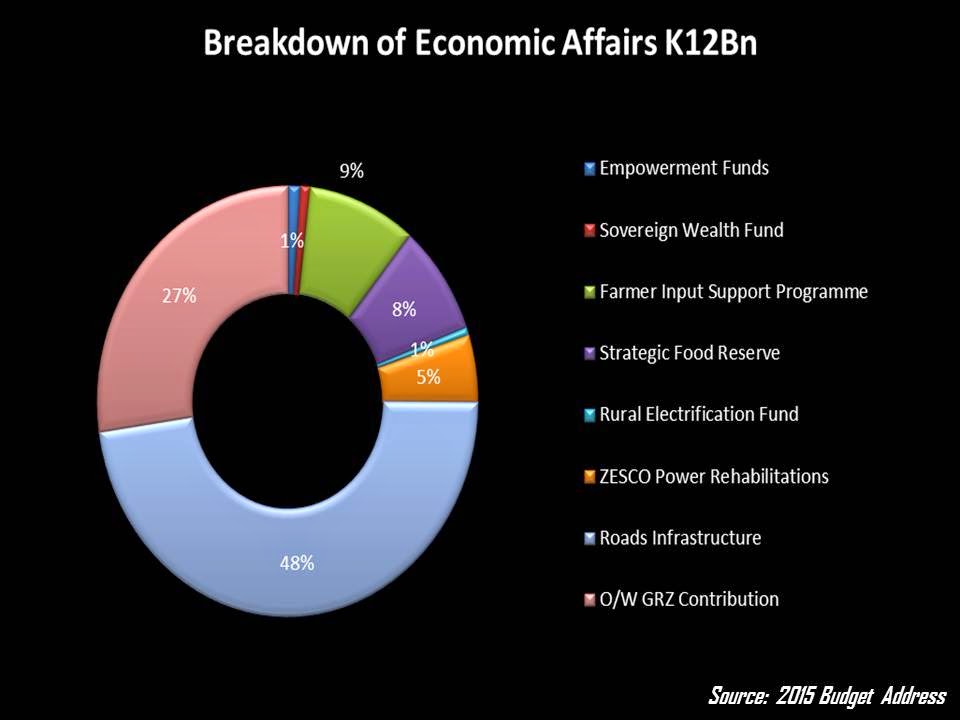
Government proposes to spend K12.7 billion or 27.3 percent of the total budget to support the economic sectors and lays the basis for further prosperity for our people. In this regard, an allocation of K5.6 billion has been set aside for road infrastructure, including the Link Zambia 8000 and the Pave Zambia 2000 projects.
Diversification from maize remains paramount in attaining more inclusive growth and economic independence. In this regard, K254.9 million has been allocated towards the E-Voucher System which will allow farmers more flexibility of choice in the inputs they receive. A further, K1.1 billion has been allocated to the Farmer Input Support Programme (FISP). In 2015, it is expected that 1,000,000 farmers will access inputs through the E-Voucher and FISP programmes.
Government will continue promoting private sector participation in grain marketing by limiting grain purchases by the Food Reserve Agency to the 500,000 metric tonnes required for the strategic food reserve. In this regard, Government has provided K992.9 million for strategic food reserves.
To promote irrigated agriculture and increased access to water resources, Government has allocated K164.5 million towards the construction and rehabilitation of dams to achieve our target of an additional 17,500 hectares under irrigation by 2016.
To promote livestock and fisheries, Government has allocated K307 million for livestock disease control measures and aquaculture development.
To address the challenges posed by the ever growing demand for electricity, Government has provided K600 million to ZESCO for power generation, transmission and distribution. A further K70.7 million has been allocated to increase the number of rural communities across the country connected to the national grid under the Rural Electrification Programme.
To continue nurturing the entrepreneurial spirit Government has allocated K123.7 million to various empowerment funds that cater for the youth, women and SMEs
Government has allocated K100 million for the establishment of a sovereign wealth fund. Going forward, a significant propotion of the dividends from state-owned enterprises that will fall under the Industrial Development Corporation will form part of the fund.
1.3.1.3. Education and Skills Development
Government proposes to spend K9.4 billion or 20.2 percent of the total budget in the education sector. In an effort to reduce the pupil teacher ratio, 68 percent of this amount will go towards the recruitment of 5,000 teachers and sustaining the current establishment. Government has also provided K1.1 billion for infrastructure development for early childhood, primary and secondary education.
K650 million has been allocated to commence construction of additional student accommodation at the University of Zambia, Copperbelt University, Mulungushi University and Evelyn Hone College, and to continue the construction of new universities. The new Universities that are earmarked for completion in 2015 are Paul Mushindo, Chalimbana and Palabana.
Government will embark on the construction of King Lewanika and Luapula Universities in 2015.Robert Kapasa Makasa, Mukuba and Kwame Nkrumah Universities are almost completed.
A further K79.6 million has been allocated towards the construction of nine trades training institutes across the country of which three will be completed in 2015 in Isoka, Kalabo and Mwense. In addition, K28.5 million has been allocated towards the procurement of research and development equipment as well as the commencement of the construction of a National Science Centre in Chongwe, a Fisheries Centre in Samfya and a Mineral Research Centre in Solwezi.
To address the challenges facing our vulnerable school leavers to access tertiary education at our colleges and universities, Government has raised the allocation to bursaries by 27.9 percent to K200.2 million from the 2014 allocation of K156.5 million. The cost of publicly provided tertiary education per student is among the highest in the SADC region.
1.3.1.4. Health
In line with Government’s objective of providing equitable access to quality health care, Government has allocated K4.5 billion or 9.6 percent of the overall budget in 2015 to the Health Sector. Of this allocation, K268.2 million has been allocated for the construction and rehabilitation of health infrastructure in various parts of the country.
An allocation of K753.5 million has been set aside for the procurement of essential drugs and medical supplies. K52.5 million has been allocated for the net recruitment of over 2,000 health personnel.
1.3.1.5. Housing and Community Amenities
Government has allocated K798.7 million for housing and community amenities, of which K541 million will be for the rehabilitation and construction of water supply and sanitation infrastructure in the rural, peri-urban and urban areas.
1.3.1.6. Public Order and Safety
K2.2 billion has been allocated to maintain public order and safety. Key interventions will involve modernisation of our security wings; recruitment of security personnel including immigration and prison officers; rehabilitation of prison infrastructure; and construction and rehabilitation of staff houses.
1.3.1.7. Social Protection
Government has provided K1.3 billion for social protection of which K805 million is for the Public Service Pension Fund, K180.6 million for the social cash transfer scheme and K50 million for the food security pack. The allocation to social protection translates to 2.7 percent of the overall expenditure in 2015.
1.3.1.8. Other functions
K3.7 billion has been allocated to the remaining functions of Defence, Environmental Protection and Recreation, Culture and Religion. Of this amount, K3.2 billion is for Defence.
1.3.2. Revenue Estimates and Financing
The proposed revenue measures have been framed in the context of Government’s aim to consolidate its fiscal position and make the tax system simpler and more effective. This entails, inter alia, accelerating the modernisation of tax administration and restructuring the current mining tax regime in order to capture more resources to address public expenditure needs.

1.3.2.1. Revenue Measures

Government proposes to double the presumptive tax payable by these operators. This measure will raise additional revenue of K3.8 million.
Government proposes to increase the specific duty rate on refined edible oil to K2.20 per kilogram from 85 Ngwee per kilogram in order to bring it at par with the ad valorem rate of 25 percent charged on imported refined edible oil
In order to stimulate the local manufacturing industry and sustain employment in the sector, Government proposes to increase customs duty on explosives to 25 percent and on roofing sheets to 30 percent.
Government proposes to increase excise duty on imported un-denatured spirits of alcoholic content of 80 percent or higher by volume to 125 percent from 0 percent. This proposed measure will only apply to importers who are not licensed to manufacture excisable products while the licensed manufacturers will continue to account for excise duty at the point of sale of the manufactured potable spirits at the current excise duty rate of 60 percent.
Government proposes to remove the 5 percent customs duty on aviation fuel in order to reduce costs in the aviation industry. As a result of this measure Government will forego K6.3 million in revenue.
1.4. Changes to the Mining Fiscal Regime
Government and the mining companies, Government proposes to redesign the mining fiscal regime by replacing the current two tier system with the following simplified mining tax structure:
a) 8 percent mineral royalty for underground mining operations as a final tax;
b) 20 percent mineral royalty for open cast mining operations as a final tax;
c) 30 percent corporate income tax rate on income earned from tolling; and
d) 30 percent corporate income tax rate on income earned from processing of purchased mineral ores, concentrates and any other semi-processed minerals, currently taxed as income from mining operations.
The proposed changes to the mining tax regime will not apply to mining of industrial minerals. The expected additional revenues, in 2015, as a result of these new measures are estimated at K1.7 billion.

Analysis

The 2015 Budget is in line with the Medium term expenditure framework (2015-2017). The contentious issue arising from this budget is most prominently the Wage Freeze. In September 2013 the Zambian Government approved a harmonious increase of wages for civil servants. The increase was as much as 100% for some civil servants. The wage increase was much anticipated but its size was larger than predicted. To balance this out the Government introduced a wage freeze on the salaries of civil servants for 2 years.There have been calls from people in the media and others to drop the wage freeze.In truth and in free market legality the Government was not supposed to impose a wage freeze. But a closer look at the fiscal position indicates that Government cannot actually afford to drop the wage freeze right now after the unilateral increase in 2013. Unions will continue to fight the wage and they should (its their job) but the wage freeze might only be dropped in 2016.

The mining fiscal regime change is a bold move towards royalty taxes and its success will hinge on the Zambian Governments ability to actually monitor and evaluate the effectiveness of the new tax system.

Debt levels of $4.7 billion and K21.9 billion for external and domestic debt remain within international standard thresholds. This however should not undermine the need for greater fiscal management.

In terms of Allocations, a bulk of the economic affairs, similar to last year is still going to the Roads sector. The introduction of the Local Government Equalisation Fund.will be interesting to see how it pans out.
It is motivating to see that the constitution process has been budgeted for, what is intriguing is to what level of the process will these funds move the draft constitution.
The doubling of presumptive tax on public service vehicles is reasonable and will help reduced "free riding". Other import duties on edible oils and roofing sheets will go a long way to help the local manufacturing companies.The removing of 5 percent customs duty on aviation fuel will also help improve the profitability of the aviation industry which should translate into better tourism packages and numbers of visitors.

The 2015 Budget did not address the 2014 inflation targets which according to our current trajectory Zambia will not be able to meet.In the 2014 Budget Zambia estimated and inflation rate of 6.5%, Inflation now stands at 7.8%.This is the reason even the 2015 inflation projections were revised upwards to 7%. Growth will be much in line with projections for 2014 and 2015 driven by the Governments ambitious infrastructure programme, Agriculture, manufacturing, transport and communications.

Click the link below to download the full analysis

2015_Zambia_Budget_Analysis

Thursday, October 2, 2014

VAT Rule 18 Analysis : The Amber Rose and Wiz Khalifa Example by Kampamba Shula


VAT Rule 18: Background and Current Affairs
Valued Added Tax Rule No. 18 has been in existence since 1997 with the intention of making Zambian exports competitive through VAT refunds on exports.
Under Rule 18, the requirement to obtain information from importers outside Zambia’s jurisdiction has proved impractical and results in delayed processing of VAT refunds.
According to a letter by Minister of Finance Alexander Chikwanda to President Michael Sata, seeking his guidance on VAT tax administrative Rule 18, he stated that the uncleared backlog with the mines was in excess of $600 million (K3.6 billion).
Against this backdrop, the Zambia Revenue Authority (ZRA) has amended Rule 18 of the Value Added Tax (VAT) General Rules of 1997 to safeguard Government revenue with effect from September 8, 2014.
ZRA commissioner general Berlin Msiska says Rule 18 affects exporters and the mining sector.
In 2013, the Zambia Revenue Authority (ZRA) amended the rule by way of Gazette Notice No. 26 of 2013 which adjusted all VAT returns to standard rate export sales until proof of compliance to the rule has been made in order for exporters to claim VAT refunds.
According to a letter written by ZACCI president Geofrey Sakulanda to Minister of Finance Alexander Chikwanda, ZACCI highlighted some of the challenges of VAT rule 18 for the minister’s possible consideration.
Mr Sakulanda outlined that prior to the 2013 amendment act, compliance to this rule had been by way of providing to the Zambia Revenue Authority ( ZRA), the documentation of invoices issued by the exporting company, duly completed export documents (Form CE20), release orders by ZRA confirming exit at the border and proof of payment into the company’s bank account.
However, Mr Sakulanda noted that the amended VAT rule 18, in part, particularly Rule 18 (1) (b), requires that in addition to the requirements above, an exporting company must also provide copies of import documents for the goods bearing a certificate of importation into the country of destination provided by the customs authority of that country as proof of export.
He argues that the amended VAT rule No. 18, has its own challenges.
Among such challenges is the requirement to produce copies of import documents for the goods, bearing a certificate of importation into the country of destination provided by the customs of that country as proof of export.
Mr Sakulanda stated that exports made to clients in the export markets on such terms that once a consignment is handed over to the client’s agents, the responsibility of the exporter is terminated and the exporter has absolutely no control over the consignment from that point and export invoices are based on the terms of sale.
“It is challenging to obtain information documents to prove importation in most of the export markets for Zambian products. This situation is even worse in one of Zambia’s key export destinations, namely Democratic Republic of Congo (DRC).
“Exporters are not in any way averse to complying with the law but need special consideration to find practical solutions to dealing with this challenge. This situation is detrimental, as it erodes competitiveness especially that our competitors in the regional markets do not require that similar documents to be produced,” Mr Sakulanda said.
VAT Rule 18: The Amber Rose and Wiz Khalifa Example (Ficticious)


(All Characters Ficticious)
A recently divorced couple by the name of “Wiz Khalifa” and “Amber Rose” have son called “Sebastian”.According to the prenupt they signed before marriage, in the case of divorce Wiz Khalifa is required to pay alimony and Child support (depending on custody court case) to Amber Rose per month. For the sake of this example, let’s put Alimony and Child support in one category and call it “VAT”.
Now according to the prenuptial, Whenever Amber rose buys stuff for their son Sebastian she is allowed to claim to be refunded (payed back) from VAT. One of the conditions in VAT is that Amber rose is supposed to provide receipts of every transaction which she buys stuff for Sebastian. This condition is sensible in theory but is a bit difficult to apply in practice. Amber rose can give her friend to take Sebastian to a movie when she is busy and her friend may lose the receipt on the way back. This makes it difficult for Amber to produce a receipt. This condition is difficult to apply so sometimes she usually doesn’t produce a receipt but still gets refunded VAT.
Sometime later, one of Wiz Khalifa’s friends tells him that he has been seeing Amber going to get a lot of expensive manicures, shopping etc. and suspects that the money is from VAT which is supposedly for Sebastian. What makes it worse is that Wiz Khalifa hears that Amber Rose has been seen chilling with a guy called Nick canon and spending money on him.This makes him angry. So this is what Wiz Khalifa decides to do, he enforces the rule that Amber has to provide receipts for every transaction on which she spends money on Sebastian. Similar to before, Amber is unable to provide receipts for some payments for Sebastian which she does through her friend. Wiz decides to hold any refunds until Amber can provide receipts of payments some of which she pays through other people who are not so mindful of the receipts. Therein lies the stale mate.
Now is Amber Rose legally entitled to refunds from VAT, yes. Is Wiz Khalifa legally allowed to withhold VAT until Amber provides receipts, yes. Now Wiz Khalifa legally has to pay Amber Rose the VAT refunds but he has a legitimate reason to ensure that Amber Rose actually spends the money on his son Sebastian.
There are two options
1. Wiz Khalifa can wait till the court case in which Amber Rose will invariably win that he has to pay her the Refunds
2. Wiz Khalifa will need to be level headed. He will legally request (subpoena) a trail of money payments from Amber Rose. This trail will detail for example which friends (yeah they get subpoenaed too) take Sebastian for a movie and where they put their receipts. Wiz Khalifa can then by form of subpoena find out exactly how much money is given to the friend for the movie and whether it corresponds to the amount Amber Rose Claims on VAT. This method is obviously harder because Amber Rose’s friend is not bound by the same legality.But unfortunately is the only logical course of action. In the long run Wiz Khalifa will have to give room for Amber Rose to find a way to comply her friends to product receipts.
Now in this story, Wiz Khalifa is the Zambian Government and Amber Rose is the Mining consortium. VAT refunds refer to the Value added tax refunds that the Zambian Government through ZRA is legally obliged to pay the Mines for exported goods. Now the condition that Amber Rose had to comply with to provide receipts for payments made for Sebastian is the condition that Mining companies must comply with by providing import certificates from the country to which they export.
The problem is that mining companies for example that sell copper to China would use a middle man in London. This middle man may use a future (financial agreement) to broker the deal. He doesn’t provide mining companies with import certificates which the buying party in China is supposed to provide.
There is a solution to this problem, Solution 2. The Zambian Government must legally request (Subpoena) all the Mining companies to disclose all the middle men they sell too. These middle men will then ALSO have to be subpoenaed to provide their end sources. The importing buyers will disclose which country they operate in and a memorandum of understanding will have to be signed with the customs authority in that country.In the long run mining companies will need to be given time and support so the can ensure that their middle men get copies of import certificates from the destination countries. It’s either this or VAT Rule 18 gets amended, Again.
As it stands now in a stalemate, the Government can either pay the Mines back the Vat Refunds or it can modify VAT rule 18 so that exports are Zero rated in the first place.But Zero rating is not really an option on the table so the Government will have to be smarter about the transparency.
That transparency is open to interpretation.

Friday, September 19, 2014

Medium Term Expenditure Framework (2015-2017) Review and 2015 Budget Projections by Kampamba Shula

Medium Term Expenditure Framework (2015-2017) Review and 2015 Budget Projections

Click here to download via Academia

1.1.       Introduction

The 2015 – 2017 Medium Term Expenditure Framework (MTEF) has been formulated with the overall objective of enhancing the benefits to citizens from the positive economic growth that has been achieved over the past few years. This is in line with the spirit of the Revised Sixth National Development Plan (R-SNDP) which is “people-centered economic growth and development”.
Government will focus on ensuring that growth is inclusive and propoor so that the benefits of a stable macroeconomic environment, positive economic growth and single digit inflation bring about improved standards of living for the Zambian people. This will be done by stepping up both human effort and financial resources in areas that have a direct impact on the improvement of individuals’ quality of life, such as education and skills development, health care, agricultural support, citizen empowerment, employment creation, provision of public infrastructure and social amenities. With these interventions the Government is confident that inroads will be made in creating jobs, raising incomes and reducing poverty

1.2.       MACROECONOMIC OVERVIEW

1.2.1.      Developments in the Global Economy

Global economic growth is projected to strengthen to 3.6 percent in 2014, from 3.0 percent in 2013, led by the advanced economies. The United States is projected to record growth of around 2.0 percent, due to a pick-up in domestic demand. In the euro zone, a turnaround from minus 0.4 percent in 2013 to 1.0 percent is projected in 2014, driven by Germany and the recovery in Spain and Italy.
Growth in Sub-Saharan Africa is expected to strengthen to 5.4 percent in 2014. Growth in South Africa is projected to improve modestly as the result of stronger external demand, which will be dampened by the effects of labour strife especially in the mining sector. Commodity-related projectselsewhere in the region are expected to support higher growth.


1.3.        

1.4.       Developments in the Domestic Economy

In the domestic economy, real GDP growth is projected at 6.5 percent in 2014, down by 0.2 percentage points compared to 2013. This growth is expected to be driven by the, mining, construction, and energy sectors and the favourable performance recorded in the agricultural sector in the 2013/2014 farming season. The overall budget deficit in 2014 is projected at 5.1 percent of GDP, lower than the 5.5 percent factored in the 2014 Budget. It is projected that total revenues and grants will reach 19.0 as a percent of GDP while expenditures are projected to reach 24.1 percent of GDP. Despite the increase in the inflation rate, maintenance of single digit inflation rate remains feasible, premised on measures taken to limit the slide of the Kwacha and a reduction in food prices as the 2013/2014 season’s harvest comes on market.
In the foreign exchange market, the Kwacha depreciated by 13.6 percent in the first half of 2014 to close at K6.2601/US$ as compared to a depreciation of 5.3 percent in the first half of 2013 when it closed at K5.4172/US$. The depreciation of the Kwacha was attributed to a combination of international and domestic factors. The continued relatively lower copper prices in 2014 compared to 2013 on the international market, and their consequent impact on the country’s Balance of Payment (BOP) position resulted in negative investor perceptions of the Kwacha. Domestically, liquidity levels and the comparatively high Rand purchases on the inter-currency segment of the market using the US dollar, contributed to the dollar being scarce.

1.5.       Macroeconomic Framework, 2015-2017

Government policies will continue to focus on creating jobs and reducing poverty and inequality on a sustainable basis. This will be achieved by investing in sectors that have been identified to best promote employment, significantly increase productivity in the economy, contribute to higher and inclusive economic growth, and develop the rural areas. These include the agriculture, tourism, manufacturing and construction sectors. Additionally, for inclusive growth, emphasis will be placed on investing in the social sectors.
The specific broad socio-economic policy intentions during the MTEF period will be to:
1) Achieve an average annual real GDP growth rate of above 7 percent;
2) Maintain single digit inflation;
3) Increase international reserves to 4 months of import cover by end 2017;
4) Raise domestic revenue collections to over 18 percent of GDP;
5) Contain domestic borrowing to less than 2 percent of GDP by 2017
6) Accelerate the diversification of the economy;
7) Continue to promote Zambia as an investor friendly destination and continue with structural reforms aimed at reducing the cost of doing business; and
8) Accelerate the implementation of interventions in the health, education and water and sanitation sectors.


1.6.       Medium Term Expenditure Forecasts


·         Total expenditures (excluding amortization) are expected to increase from K44.3 billion in 2015 to K54.1 billion in 2017 which will translate to an average of 22.8 percent of GDP over the period.
·         Expenses are projected at an average of 16.5 percent of GDP. The other major spending allocations will be on assets at an average of 6.1 percent of GDP. Liabilities are expected to decline to an average of 0.2 percent of GDP as a result of Government’s efforts to control expenditure commitments.
·         In view of the gap between expected revenues and expenditures, Government expects to incur an overall fiscal deficit of 4.4 percent of GDP in 2015, 4.1 percent of GDP in 2016 and 3.2 percent in 2017


1.7.        

1.8.       Revenue

The Government plans to enhance domestic revenues by implementing, among others, the following policy and administrative measures:
·         Stiffen sanctions for tax evasion. This measure is intended to enhance the disincentive for tax evasion and ensure that all economic actors recognize the negative effects of tax evasion and are compelled to fully meet their tax obligations.
·         Set up a multidisciplinary task force consisting of security wings and the Ministry of Finance to undertake spontaneous tax inspections to curb smuggling, illicit trade, under-declarations and corruption, particularly at border points, and related tax malpractices. The current investigative mechanisms for tax fraud have proved to be ineffective and therefore this raises the need for more robust ways to curb these vices. The creation of this structure will complement the efforts of the Mobile Compliance Unit.
·         Introduce measures to promote the production and consumption of goods which can be produced locally by Zambian companies.
Following the liberalization of the economy and the signing of trade protocols, Zambia’s external competitiveness has not been favourable resulting in the closure of many companies, loss of employment and the country becoming a net importer of almost all products.
2015 Budget Projection
2016 Budget Projection
2017 Budget Projection
Projected
% of GDP
Projected
% of GDP
Projected
% of GDP
I Revenue and Grants
35,874,923.60
18.9%
40,879,958.90
18.9%
46,280,275.00
18.9%
II Revenue and Budget Support
34,294,923.60
18.1%
39,299,958.90
18.1%
44,700,275.00
18.3%
III Revenue less mining
28,260,715.50
14.9%
32,010,629.80
14.8%
36,050,542.80
14.7%
IV Domestic Revenue
34,294,923.60
18.1%
39,299,958.90
18.1%
44,700,275.00
18.3%
Tax Revenue
25,227,605.60
13.3%
28,869,383.60
13.3%
32,795,522.70
13.4%
a. Income Tax
11,731,377.40
6.2%
13,464,276.80
6.2%
15,298,127.60
6.3%
Company Tax
2,395,602.20
1.3%
2,734,776.30
1.3%
3,086,731.10
1.3%
Pay As You Earn (PAYE)
7,408,869.50
3.9%
8,529,779.60
3.9%
9,728,580.50
4.0%
Other Income tax
1,926,905.60
1.0%
2,199,720.80
1.0%
2,482,816.10
1.0%
c. Value Added Tax (VAT)
6,576,733.30
3.5%
7,601,498.30
3.5%
8,760,346.10
3.6%
d. Customs and Excise Duty
6,858,906.40
3.6%
7,732,570.20
3.6%
8,655,161.30
3.5%
Customs (Import Tariffs)
3,260,288.10
1.7%
3,624,452.40
1.7%
4,018,345.10
1.6%
Excise Duties
3,598,618.30
1.9%
4,108,117.90
1.9%
4,636,816.20
1.9%
Export Duty
60,588.50
0.0%
71,038.30
0.0%
81,887.70
0.0%
Non Tax Revenue
9,067,318.00
4.8%
10,430,575.30
4.8%
11,904,752.30
4.9%
IV Grants
1,580,000.00
0.8%
1,580,000.00
0.7%
1,580,000.00
0.6%
Direct Budget Support
-
0.8%
1,580,000.00
0.0%
1,580,000.00
0.0%
Project Support
1,580,000.00
0.7%
0.6%


1.9.        

1.10.    Expenditure

2015 Projection
2016 Projection
2017 Projection
K’000
% of GDP
K’000
% of GDP
K’000
% of GDP
Expenses
32,183,922
17.0
36,431,835
16.8
38,526,774
15.8
Assets
11,720,479
6.2
12,887,531
6.0
15,195,685
6.2
Liabilities
382,029
0.2
354,068
0.2
354,068
0.1
Total Expenditure
44,286,431
23.3
49,673,434
22.9
54,076,527
22.1
Government overall expenditure policy for the period 2015 – 2017 will focus on prudent use of public resources to ensure the effective and efficient delivery of public services and development and maintenance of vital socioeconomic infrastructure. Government’s strategy, therefore, will be to constrain expenditure on non – priority programmes and directing resources towards programmes that will improve service delivery. This will entail, among other things, reorienting expenditures towards identified pro-poor growth programmes in areas of infrastructure development in education, health, agriculture and water supply and sanitation.
·         Government will focus on providing sufficient resources towards infrastructure development, particularly with the aim of completing projects already under construction
·         Government will constrain non – priority spending, vis-à-vis ublic service delivery, and focus resources on programmes outlined in the Revised Sixth National Development Plan (R-SNDP).
·         Efforts will thus continue with the scaling down of lower priority expenditure items which include, workshops, public functions, local and foreign travel and procurement of movable assets such as motor vehicles
·         Government will dispose of excess utility vehicles to rationalise expenditure on transport.
·         Government will also place emphasis on strengthening the egovernance project which is aimed at integrating and rationalising the information and communication technology systems in the public service.


1.10.1.   Personal Emoluments

Government’s objective on personal emoluments is to contain the public service wage bill within sustainable levels in order to create more fiscal space for developmental and service delivery expenditures.
In this regard, Government proposes to reduce expenditure on personal emoluments as a share of domestic revenues from 52.5 percent in 2014 to 45.8 percent in 2017. This translates to K16.6 billion or 8.8 percent of GDP in 2015 and K20.5 billion or 8.4 percent of GDP in 2017

1.11.    Allocations

1.11.1.   2015-2017 MTEF Functions of Government (As Share of Total Budget)


1.12.    2015-2017 Budget Projections

Function
2014 Approved Budget
2015 Projection
2016 Projection
2017 Projection
2015-2017 Average
General Public Services
25.1%
24.4%
25.4%
22.5%
24.1%
Defence
6.4%
6.4%
6.4%
6.3%
6.3%
Public Order and Safety
5.0%
4.9%
4.9%
4.9%
4.9%
Economic Affairs
28.0%
28.0%
28.4%
30.1%
28.8%
Environmental Protection
0.4%
0.4%
0.4%
0.4%
0.4%
Housing and Community Amenities
1.5%
1.6%
1.6%
1.5%
1.5%
Health
9.9%
9.7%
9.7%
9.8%
9.7%
Recreation, Culture and Religion
0.7%
0.7%
0.7%
0.7%
0.7%
Education
20.2%
21.2%
19.9%
19.9%
20.3%
Social Protection
2.8%
2.7%
2.8%
4.0%
3.2%
Total
100.00%
100.00%
100.00%
100.00%
100.00%


1.13.    2015 Budget Projections


Government proposes to spend
 K11.2 billion in 2015 on General Public Services,K12.9 billion in 2015 on Economic Affairs,K9.8 billion in 2015 on Education,K4.4 billion in 2015 on Health,K285 million in 2015 on Housing and Community Amenities
The remaining functions of defence, environmental protection, social protection and recreation, culture and religion will account for an average of10.6 percent of total expenditure over the medium term.